
Football Betting Odds, Virtual Football, 2X Meaning, and Neural Network Prompts: A Practical Guide
The betting market is not a prediction engine. It is a pricing mechanism. Football betting odds move because money flows to one side, not because a team suddenly improved. For a practical approach, treat every price as a number to beat, not a logo to back. This guide covers how to read football betting odds, why virtual football betting runs on a different logic, what does 2x mean in football betting, and a ready-made prompt for a neural network for football betting.
To make the mechanics concrete, consider a home team at -125 on the moneyline, a total of 2.5 goals with the over at -105, and a spread of -0.5 at -105. That is the starting point.
Football Betting Odds: Price, Market Context, and Line Shopping
A standard football betting board has three core markets: the moneyline, the spread, and the total. The moneyline is the price to win outright. A home team at -125 risks $125 to win $100. The spread in soccer is usually -0.5 or +0.5 goals, priced around -110 each side. The total is often 2.5 goals, with the over at -105 and the under at -115 depending on team styles.
That line is a market context, not a verdict. If a match between a pressing home side and a low-block away team opens with total 2.5 at -110 over, that number implies a 52.4% break-even probability. Your job is to compare that to your own projected probability. If you project over 2.5 goals at 58% across five recent matches for both teams, that is an edge. If your model says 50%, no bet.
Closing line value is a key discipline term. If you take a total at -110 and it closes at -125, you have positive closing line value because you likely beat the market. If the price moves from -110 to +100, reassess or pass. Unit size also matters. Bet 1-2% of bankroll per play. With a $1,000 bankroll, one unit is $10 to $20. Never double after a loss.
Line shopping is not optional. A $100 bet at -105 pays $95.24 profit; at -115 it pays $86.96. Over 100 bets, that 10-cent difference is hundreds of dollars. Compare at least two bookmakers before placing any football bet.
Virtual Football Betting: Fixed Probability, No Weather, Fast Cycle
Virtual soccer matches are generated by algorithms using historical data and fixed probabilities. They run 24/7 without weather or season disruptions, and results are pre-calculated and then displayed. That makes the environment stable but not organic. You are not betting on a team’s mood, an injury, or a manager change. You are betting on a probability distribution that the bookmaker already knows.
Virtual football betting odds may come with a higher bookmaker margin than real matches because the event is manufactured and the bookmaker controls the algorithm. That does not make virtual football unbeatable, but the bar is higher. Analyze generated patterns such as score frequencies, streak lengths, and favorite win rates across a large sample, not a single outcome. For example, if a virtual league shows home teams winning 42% over 500 matches and the odds imply a 45% home win probability, the house edge is already inside that gap. Pass unless the line is mispriced enough to overcome the margin.
In virtual football betting, use fixed unit sizes of 1% or less. Avoid betting a side at -150 or shorter unless you have tracked at least 200 generated matches from that specific tournament. A pattern of 10 overs in a row is not a system; it is a coin-flip streak in a pre-calculated sequence.
What Does 2X Mean in Football Betting? Double Chance Explained
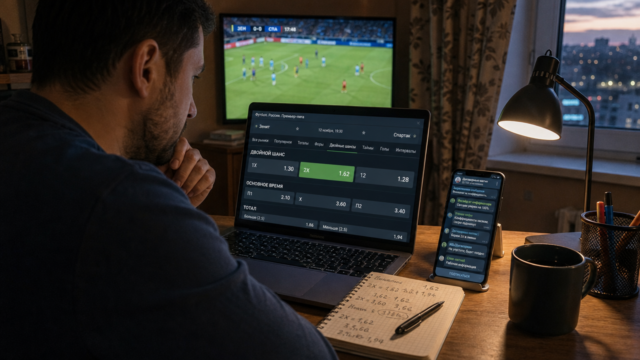
Double chance X2 means the second team draws or wins. It covers two of three regulation-time outcomes: away win and draw. The only losing scenario is a home win in 90 minutes. Extra time and penalty shootouts do not count, and there is no refund. The same market can apply to full-time result or statistical markets like corners, where X2 corners means the away team wins or ties the corner count.
Suppose a home team is -150 on the moneyline and the draw is +240. The X2 for the away side might be -120. If you bet $100 on X2 at -120, you profit $83.33 if the match ends in a draw or away win. You lose $100 if the home team wins. That is a different risk profile than betting the away team to win outright at +220, where a draw loses.
Compare X2 with the away team spread +0.5. Both cover a draw or away win. If X2 is -120 and the away team +0.5 is +100, the spread is the better price for the same underlying outcomes, unless the draw in that league is unusually high. In a low-scoring league where 31% of matches end level, X2 might be priced more efficiently than +0.5. Check current form, motivation, head-to-head record, home/away splits, and the injury report before taking a side. Home advantage matters: a team with +0.8 xG at home and +0.2 away is not the same as a neutral team.
One concrete trigger: take X2 only when the away team’s moneyline is +150 or shorter and the draw is +240 or longer, because the combined break-even is around 66% and the price should stay better than -150. Adjust based on team data.
Ready-Made Prompt for a Neural Network for Football Betting
AI models do not eliminate risk. They organize data. Use a prompt that asks for structured output, not a guaranteed pick. A ready-made prompt for a neural network for football betting could be:
Act as an experienced football betting analyst. Analyze the following match: [home team] vs [away team] on [date and league]. Use available statistical data sources only. Provide these outputs:
- Predicted score and probabilities for home win, draw, away win, over 2.5 goals, and under 2.5 goals.
- Three key statistics with xG, shots on target, and team form over the last five matches.
- A risk assessment from 1 (low) to 5 (high) with one recommended market or a pass.
- A recommended stake in units from 0 to 2, where 0 means no bet.
- The best odds found and the bookmaker name.
After you receive the output, check the injury report and line movement. If the model predicts a 58% chance on over 2.5 but the best price is -135, the break-even is 57.4%, so the edge is less than 1%. That is not worth a full unit. If the price drops to -115, the edge improves. Never accept a model’s “lock” label; a neural network cannot see line moves, late team news, or the difference between a main market and a statistical market. Use it to generate a shortlist, then only bet when the price matches your own edge.
A beginner should start with markets that have clear rules and enough liquidity:
- Outcome (1X2)
- Double chance (including X2)
- Total goals (often 2.5)
- Yellow cards
- Corners
Use match calendars and compare odds across bookmakers. Check football, hockey, and esports fixtures where relevant, and compare the odds from two or three books before placing any wager.
Final betting condition: Bet any football side or total only if the price you can get is at least 10 cents better than your model’s fair price. For virtual football betting, pass on any -150 or shorter favorite unless you have 200 matches of tracked pattern data. For 2X, take it only at -150 or better when the away team is +150 or shorter and the draw is +240 or longer. If the best available X2 is -165 or worse, pass. There is always another match.